Blog Details
How Treated Wood Is Transforming Building Practices Across India
For decades, wood in Indian construction was treated as a luxury finish — something reserved for doors, furniture, or decorative details. Builders leaned heavily toward concrete, steel, and brick because those materials promised strength, longevity, and reliability.
But something is shifting.
Across residential projects, institutional buildings, hospitality spaces, and urban outdoor structures, treated wood is steadily moving from the periphery to the core of construction choices. Not because it’s trendy — but because it solves real challenges: climate endurance, durability, sustainability, and maintenance efficiency.
In a country with diverse climatic zones — humid coasts, monsoons, heat extremes, termites, and rapid urbanization — treated wood isn’t just another material. It represents a smarter way to build.
What Makes Treated Wood Different?
Treated wood is natural timber enhanced through scientific processes to improve its resistance to moisture, decay, pests, and environmental stress. The treatment can be chemical, thermal, or biochemical depending on the required performance and use case.
Three primary treatment approaches are now common in India:
1. Pressure-Treated Wood
Preservatives are injected deep into the wood under high pressure. The treatment penetrates beyond the surface, offering long-term protection from rot, fungi, and insects — especially termites, one of India’s biggest threats to timber.
2. Thermally Modified Wood
Wood is heated to high temperatures in oxygen-controlled chambers. This alters its cellular structure, dramatically improving dimensional stability and reducing water absorption.
3. Chemically Treated Wood
A more advanced, eco-aligned process where the wood is chemically modified using acetic anhydride. The wood becomes exceptionally stable, durable, and long-lasting without heavy metal preservatives.
Each treatment method serves specific applications — from decking and cladding to indoor joinery and architectural detailing.
Why Construction Standards Are Changing
India’s construction landscape is evolving, and treated wood sits at the center of multiple intersecting trends.
1. Climate-Resilient Design
Heavy monsoon rainfall, humidity, and heat cycles challenge conventional materials. Treated wood performs better because:
- It doesn’t absorb moisture as rapidly
- It resists fungal decay and surface mold
- It withstands seasonal expansion and contraction
This makes it suitable for spaces previously considered unsuitable for timber — balconies, façades, garden structures, and poolside elements.
2. Longevity and Low Maintenance
Traditional wooden installations often require frequent polishing, pest control, and corrective repairs. Treated wood reduces maintenance cycles and extends lifespan by 3–5 times compared to untreated wood — a major advantage for both individual homeowners and large-scale developers.
3. Compatibility With Modern Construction Systems
Treated wood integrates well with:
- Steel frame systems
- Hybrid structures
- Prefabricated modular components
- Sustainable building certifications (LEED, GRIHA, IGBC)
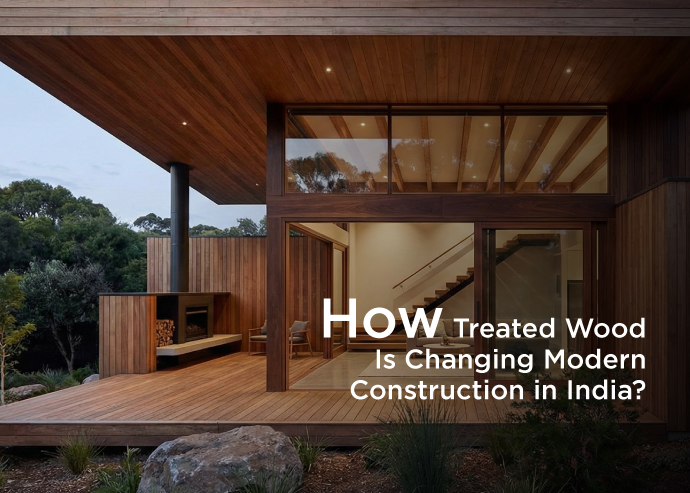
Contractors now use it for pergolas, cladding, soffits, formwork replacements, and outdoor hospitality environments — areas where untreated wood simply doesn’t survive long-term.
Performance Advantages That Matter
The rise of treated wood isn’t about aesthetics alone — although it does offer warm, natural surfaces that steel and concrete cannot replicate.
The real driver is performance.
Moisture Resistance
Monsoons and damp coastal air degrade untreated wood rapidly. Treated wood retains shape, structural integrity, and finish — even in exposed environments.
Termite and Pest Resistance
India has some of the highest termite pressure zones in the world. Treatment creates a long-lasting barrier against infestation.
Dimensional Stability
Warping, cracking, and swelling — common in untreated wood — are drastically reduced. This stability improves installation quality, fit, and finish.
Strength-to-Weight Advantage
Wood already has an excellent strength-to-weight ratio. When treated, it becomes a viable competitor to heavier engineered materials for outdoor structures.
Fire and Decay Resistance
Depending on the treatment type and application, fire retardants and anti-rot compounds further enhance safety and longevity.
A More Sustainable Building Material
Sustainability is no longer a buzzword — it’s a construction expectation.
Compared to concrete or steel, wood:
- Has lower embodied energy
- Stores carbon rather than emitting it
- Can be responsibly sourced and renewed
When wood is treated and lasts decades longer, its sustainability advantage increases significantly. Instead of replacing degraded wood every few years, one long-lasting installation reduces waste, energy use, and long-term environmental footprint.
Builders pursuing certifications or green construction frameworks increasingly adopt treated timber for its balance of sustainability and performance.
Where Treated Wood Is Making the Most Impact
In India, treated timber is gaining traction in both private and commercial spaces.
Popular applications include:
- Exterior cladding and ventilated façades
- Decks, patios, and sit-out areas
- Pergolas, gazebos, and rooftop structures
- Railings and balustrades
- Outdoor furniture
- Wooden posts and fencing
- Door and window frames exposed to weather
- Hospitality landscaping and outdoor lounges
Urban infrastructure projects are also experimenting with treated wood for pedestrian pathways, signage systems, and public park installations.
Cost: A Longer-View Perspective
Untreated wood may appear more cost-effective initially. But once you factor in:
- Repairs
- Termite treatment
- Replacement cycles
- Unpredictable environmental failures
the long-term cost tilts heavily in favor of treated wood.
Developers and homeowners are recognizing this as both a financial and logistical advantage.
What This Means for the Future of Construction in India
Treated wood is enabling architects and builders to reintroduce timber into environments where it previously wasn’t viable. Instead of avoiding wood because of climate, insects, or maintenance concerns, designers can now specify it confidently for long-term durability.
As material technology advances and awareness grows, treated wood is transitioning from a specialty choice to a standard construction material.
It represents the intersection of performance, design flexibility, sustainability, and longevity — a combination modern construction demands.
Final Thought
Modern construction isn’t just about strength — it’s about smarter material use, lifecycle performance, efficiency, and environmental responsibility.
Treated wood aligns with all four.
As India builds faster, larger, and more thoughtfully, treated wood isn’t simply an alternative — it’s becoming an essential material for structures that are meant to last.